The Numbers at a Glance
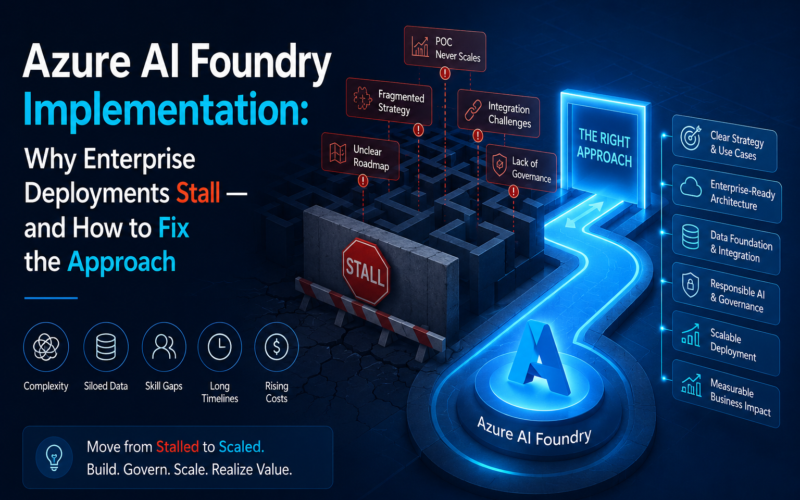
- 70–85% — AI initiatives fail to meet expected outcomes (Fullview, 2025)
- 42% — Companies abandoned most AI initiatives in 2025, up from 17% in 2024 (Fullview, 2025)
- 60% — AI leaders cite legacy system integration as their primary challenge (Deloitte, 2025)
Why AI Projects Fail: The Scale of the Problem
This is not about a few bad pilots
The statistics are difficult to ignore. Between 70% and 85% of AI initiatives fail to achieve expected outcomes. Meanwhile, organisations abandoning AI projects increased dramatically from 17% in 2024 to 42% in 2025 (Fullview, 2025).
The cost of this is not just financial. Every failed initiative makes it harder to build internal credibility for the next one. Teams become cautious. Leadership becomes sceptical. Future buy-in gets harder to secure, even when the conditions
genuinely improve.
Using AI tools is not the same as getting value from them
65% of organisations used generative AI regularly in early 2024. But only around one third report successfully scaling AI across the enterprise (McKinsey, 2025).
Many organisations have embraced tools such as ChatGPT and Copilot. However, regular usage does not automatically translate into measurable business outcomes. Regular use without integration is just experimentation with extra steps. True AI transformation happens when AI becomes embedded into workflows, decision-making, and data infrastructure.
The Top AI Implementation Challenges in 2025
What the data says
The most commonly cited AI challenges in 2025 are: data accuracy and bias (45%), lack of proprietary data (42%), insufficient AI expertise (42%), weak financial justification (42%), and privacy concerns (40%) (WalkMe, 2025).
Most Common Challenges
- Data accuracy and bias — 45%
- Lack of proprietary data — 42%
- Insufficient AI expertise — 42%
- Weak financial justification — 42%
- Privacy and compliance concerns — 40%
These are not five separate problems
These challenges are often treated as separate problems. In reality, they typically stem from the same root issue: organisations attempting to build AI on top of data environments that were never designed for AI.
A lack of proprietary data and poor data accuracy are not separate issues. You do not have the right data, and the data you do have cannot be fully trusted. Insufficient AI expertise makes this worse because teams cannot diagnose data problems they do not have the technical knowledge to spot. Weak financial justification is usually the result, not the cause.
This is why addressing one challenge in isolation almost never works. Organisations that hire AI talent without fixing their data infrastructure usually find that talent frustrated and underused within six months.
Quick AI Readiness Check
- Do we have clean, governed data that AI can actually work with?
- Can our teams validate AI outputs confidently?
- Can AI outputs be clearly linked to a specific business decision?
- Have we defined who owns and validates AI-generated results?
- Are internal stakeholders aligned on what success looks like?
If you cannot answer yes to most of these, the challenge is readiness, not technology.
Legacy Systems: The AI Challenge Nobody Wants to Fund
60% of AI leaders identify legacy system integration as their primary challenge (Deloitte, 2025). As organisations move toward AI agents that need to read from and write to live enterprise systems, this issue becomes even more significant.
Reality Check:
An AI agent that cannot connect to your ERP, CRM, or data warehouse is not delivering enterprise value. It is simply an expensive demonstration. Every month spent running AI pilots on top of fragmented legacy infrastructure is a month where the integration problem gets harder, not easier.
The companies moving fastest on AI are not always the ones with the most advanced models. They are the ones that spent the previous two or three years cleaning up their data architecture. That work is unglamorous and difficult to fund. It is also unavoidable.
What Successful Companies Do Differently
Organisations that scale AI successfully approach preparation differently. Rather than treating governance and data readiness as prerequisites, they view them as the actual AI project. The model selection, vendor evaluation,
and use case prioritisation all come later and move considerably faster when the foundation is already in place.
The Right Sequence
- Audit your data readiness and infrastructure gaps
- Define data ownership and governance policies
- Align stakeholders around outcomes, not tools
- Select AI use cases that match your current data maturity
- Choose vendors, models, and launch pilots
What We See Across Our Engagements
Across our work with mid-market clients in India, the US, and the UK, the pattern in this data plays out consistently. But there is one nuance worth adding.
The primary challenge we encounter is not technology selection or even data quality in isolation. It is the gap between what leadership believes about their data readiness and what the technical reality actually is.
Clients come in with strong AI ambitions and reasonable budgets. What they often lack are the data pipelines, ownership structures, and governance policies that give AI something reliable to work with.
We have seen pilots succeed technically, where the model performs exactly as intended, and still fail as a business initiative because no one had defined who owns the output, who validates it, or how it connects to a real decision. That failure mode does not show up in vendor evaluations. It shows up three months after go-live, when adoption stalls
and the project quietly loses sponsorship.
Fixing it requires as much attention to the human side of adoption as to the infrastructure.
Final Thoughts
The evidence is consistent across industries. Most AI projects fail not because AI technology is ineffective, but because organisations attempt deployment without the operational foundations needed for success.
The most useful next step is an honest assessment: not of which AI use cases excite you most, but of whether your current data infrastructure, team capabilities, and internal alignment can actually support them. That assessment will tell you more about your AI timeline than any vendor roadmap.
Ready to Assess Your AI Readiness?
Discover whether your data infrastructure, governance framework, and operational processes are prepared for enterprise-scale AI adoption.
Sources
- BCG Global AI Report, 2024
- McKinsey State of AI Report, 2025
- Deloitte AI Leaders Survey, 2025
- WalkMe Enterprise AI Adoption Survey, 2025
- Fullview / Industry Aggregation Report, 2025