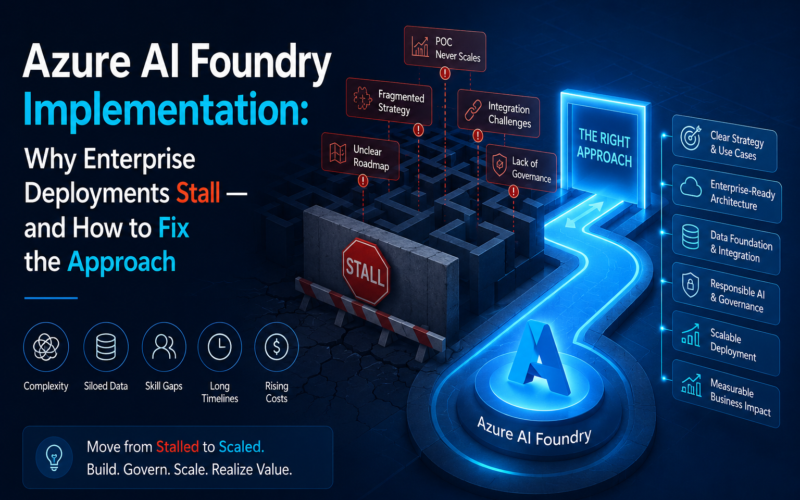
Here’s a number worth sitting with: organizations with successful AI initiatives invest up to four times more in data quality, governance, and foundational readiness than the ones whose AI projects never make it past the pilot stage (Gartner, 2026). Only 39% of technology leaders are confident their current AI investments will meaningfully move financial performance (Gartner, 2025), not because the models underperform, but because the data feeding them was never built to carry the weight.
Notice what that stat is actually about. It isn’t a story about volume. Nobody in that 4x group is winning by hoarding more data than their competitors. They’re winning by making the data they already have trustworthy, governed, and usable. That distinction — quality over quantity — is where most AI initiatives quietly go wrong, and it’s rarely the conversation companies think they’re having when they greenlight an AI pilot.
The Quantity Trap
The instinct, when an AI project stalls, is to assume the fix is more data: more sources connected, more historical records ingested, more feeds plugged in. It’s an understandable reflex — more data feels like progress you can point to. But volume without quality just gives a model more noise to learn from. Fragmented, duplicated, inconsistently labelled data doesn’t get safer to use in bulk; it gets riskier, faster.
We’ve written before about why AI projects fail more broadly — data readiness, governance gaps, legacy system integration. This piece zooms in on one specific version of that failure: the assumption that more data solves a readiness problem, when it’s usually the quality of what you already have that’s the real blocker.
That reflex is common enough that Gartner has put a number on it: 63% of organizations either don’t have, or aren’t sure they have, the right data management practices to support AI. It isn’t a data-availability problem — it’s a data-readiness one, and the two get conflated more often than they should. Left unaddressed, Gartner predicts organizations will abandon 60% of AI projects unsupported by AI-ready data through 2026.
The maturity divide in Gartner’s research bears this out too: 45% of high-maturity organizations keep their AI initiatives running for three years or more, compared to just 20% of low-maturity ones. Maturity here has little to do with how much data an organization holds. It comes down to whether that data is clean, owned, and governed enough to support a model once it leaves the proof-of-concept stage.
What Most Companies Get Wrong About the Data Question
The common assumption is that AI readiness comes down to picking the right model or the right vendor. It doesn’t. The 4x gap in foundational investment between successful and stalled AI initiatives makes it clear that the companies pulling ahead are treating data infrastructure — pipelines, governance, quality controls, access — as the actual product, with AI sitting on top of it.
Skipping that groundwork doesn’t save time. It just relocates the failure further downstream, usually after the budget and the credibility have already been spent chasing quantity instead of fixing quality.
The Return on Getting Quality Right
This isn’t an abstract argument — the returns are measurable. High-maturity organizations that invested in their data foundations report average cost savings of 15.2% and productivity gains of 22.6% from AI (Gartner, 2025). At the top end, McKinsey found that its “AI high performers” attribute more than 10% of EBIT to AI and see returns exceeding $10.30 for every dollar invested — nearly three times the average enterprise return (McKinsey, 2025).
The companies capturing that value aren’t running fundamentally different AI. They’re running it on a fundamentally different data foundation — one built for quality and traceability, not just size.
What “AI-Ready” Actually Means
Gartner defines AI-ready data narrowly: data that’s aligned to a specific use case, actively governed at the asset level, delivered through automated pipelines with quality gates, backed by live metadata, and continuously, not periodically quality-assured. Read that definition again and notice what’s missing: volume. Nowhere in it does “AI-ready” mean “a lot of it.” It means fit for the job, traceable, and current.
Most enterprise data estates fail this test not because they’re too small, but because they were built for quarterly reporting, not real-time model consumption. Data that’s “close enough” for a dashboard is often nowhere close enough for a production AI system making decisions in hours, not quarters.
What a Quality-First Approach Actually Looks Like
- Profile the specific dataset before you pipeline it — run a quality audit (completeness, consistency, duplication) on the data feeding your actual use case, not a general inventory of everything you hold.
- Fix ownership and lineage at the source, not downstream. Patching bad data inside a pipeline step is a symptom fix; the system of record it came from still needs a name attached to it.
- Set a freshness and accuracy bar tied to the use case, not a blanket policy. A model answering FAQs and one making credit decisions don’t need the same quality threshold — treating them the same wastes effort in one direction and risks failure in the other.
- Resist the instinct to add another source before asking whether it improves signal or just adds volume. An ungoverned new feed usually introduces more failure points than value.
This is also where the broader case for a data and AI foundation comes in — quality work at the pipeline and governance layer is what actually determines whether an AI investment compounds or stalls.
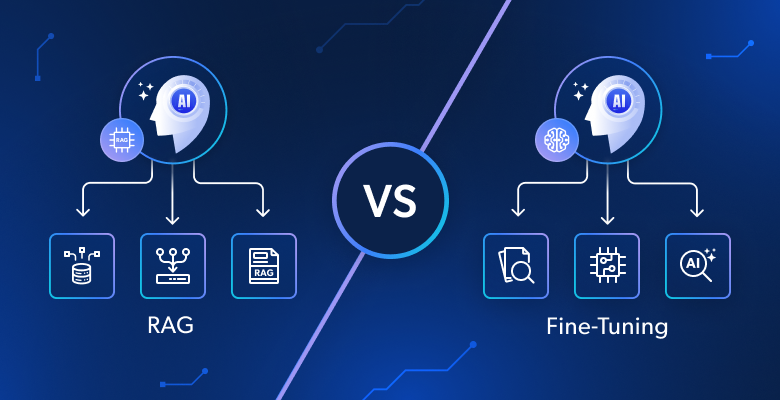
Once that foundation is in place, the next decision most teams face is architectural — our comparison of RAG vs. fine-tuning walks through how to choose between the two for your enterprise use case.
The Pattern We Keep Seeing
We see the same pattern play out across engagements, almost without exception — and it’s rarely a shortage of data. Clients often arrive with more data than they know what to do with: years of exports, logs, and records spread across systems that were never meant to talk to each other. The instinct is to treat that volume as an asset already in hand. It isn’t, until someone can vouch for where it came from and whether it’s still accurate. Clients who invest early in that kind of quality work move from pilot to production in a fraction of the time of those who don’t. The technical work of AI is often the easy part. The harder, more valuable work is turning a pile of data into something a model can actually be trusted to run on — and that’s a quality problem, not a quantity one.
The tell is almost always the same: a team can describe exactly how much data they have, but not how much of it they’d stake a business decision on. That gap — not the data’s size — is usually the first thing worth closing.
FAQ: Data Quality vs. Data Quantity
Is more data always better for training AI models?
No. More data only helps if it’s accurate, consistent, and relevant to the use case. Adding volume on top of fragmented or poorly governed data tends to amplify the underlying errors rather than dilute them.
What does “AI-ready data” actually mean?
Per Gartner’s definition, data that’s aligned to a specific use case, actively governed, delivered through automated pipelines with quality checks, and continuously — not periodically — validated (Gartner, 2025).
How much data is “enough” to start an AI initiative?
There’s no universal threshold. A smaller, well-governed dataset that accurately covers the specific decision an AI system needs to make will consistently outperform a much larger dataset that’s inconsistent or unvalidated. The right question isn’t how much data you have — it’s how much of it you’d trust a business decision on.
Where to Go From Here
The gap between AI pilots that scale and the ones that quietly die isn’t about how much data you have — it’s about whether the data underneath was ever built to support it. If your AI roadmap is further along than your data foundation, that’s the gap worth closing first.
Talk to our data and AI team about assessing where your data quality stands before your next AI investment.