50%+
Enterprise AI Models Will Be Domain-Specific By 2027
Quick Definitions
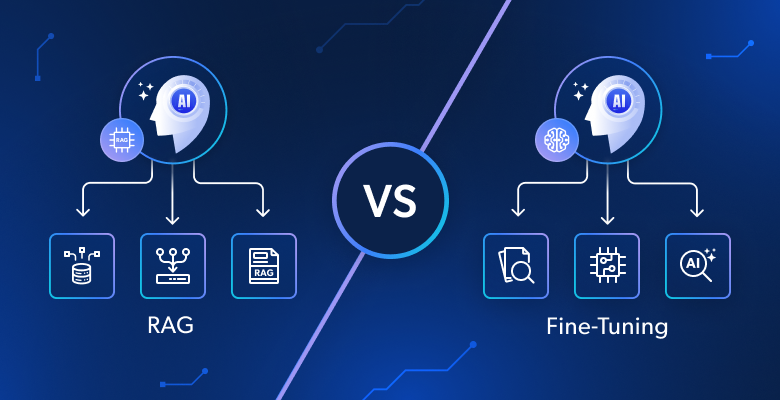
RAG
Retrieval-Augmented Generation connects an AI model to external data sources in real time so it can retrieve current information without retraining.
Fine-Tuning
Fine-tuning trains a pre-built model on your specific data, making it deeply familiar with your domain’s terminology, logic, and decision patterns.
The question is not which is better. The question is which fits your situation.
Why RAG Works: Speed Without Model Retraining
RAG lets your AI system pull current information from databases, documents, or APIs without rebuilding the model.
For industries where data freshness matters most, this is a significant operational advantage.
A customer support bot using RAG can answer questions about this quarter’s product changes immediately. A fine-tuned model may require retraining before it reflects those updates.
In fintech, retail, and healthcare, where information changes constantly, RAG wins on velocity. This is also why AI agents that interact with live enterprise systems often use RAG as their retrieval layer.
McKinsey Insight
Organisations adopting generative AI with real-time enterprise data access report meaningful improvements in productivity and decision-making speed.
Where Companies Get It Wrong
RAG is not a universal fix. If your knowledge base consists of poorly organised PDFs, legacy databases, and badly indexed file systems, RAG will simply retrieve bad information faster.
RAG Works Best When
- Your data changes frequently
- You need real-time information access
- Speed to deploy matters
- Your data is clean and indexed
Why Fine-Tuning Wins on Precision and Domain Accuracy
Fine-tuning trains a pre-built model on your specific data, making it deeply fluent in your domain’s terminology, patterns, and reasoning. It is more expensive upfront but delivers better accuracy in high-stakes workflows.
A fine-tuned banking compliance model does not simply retrieve regulations. It learns the regulatory logic embedded in your training data. That distinction matters when errors carry real consequences.
Legal review, risk assessment, and clinical decision support demand the level of precision that retrieval alone cannot
guarantee. Unlike general-purpose AI tools like ChatGPT and Copilot, a fine-tuned model is built around your specific domain logic, not a general knowledge base.
RAG retrieves relevant information. Fine-Tuning teaches the model to reason like your experts.
Fine-Tuning Works Best When
- Accuracy is non-negotiable
- Your business logic is stable
- Errors carry significant risk
- You have ML engineering resources
The Decision Framework: Three Variables That Settle It
Data Freshness
If your knowledge changes weekly, RAG is the better foundation. If your domain knowledge remains stable, Fine-Tuning delivers deeper consistency.
Cost Tolerance
RAG requires retrieval infrastructure and ongoing pipeline maintenance.
Fine-Tuning requires compute and ML expertise. Organisations that underestimate RAG’s ongoing pipeline costs often find fine-tuning would have been more economical at scale.
Accuracy Requirements
If mistakes create legal, financial, or clinical risk, Fine-Tuning is usually the safer choice. If your use case is lower-risk and speed matters more, RAG with good retrieval engineering may be sufficient.
RAG vs Fine-Tuning Comparison
| Criteria | RAG | Fine-Tuning |
|---|---|---|
| Best For | Frequently Changing Data | Stable Domain Knowledge |
| Setup Time | Days to Weeks | Weeks to Months |
| Compute Cost | Lower Upfront | Higher Upfront |
| Domain Accuracy | Moderate | High |
| Data Freshness | Real-Time Capable | Requires Retraining |
| Hallucination Handling | Partially | Better With Domain Data |
| Good Fit For | Customer Support, Internal Search | Legal, Compliance, Clinical, Finance |
The Hybrid Approach: When to Use RAG and Fine-Tuning Together
For most mature enterprise AI deployments, the answer is not RAG or Fine-Tuning. The answer is both.
RAG handles dynamic knowledge: current products, customer records, and live market information. Fine-Tuning handles domain reasoning, industry terminology, and decision logic.
The practical barrier is operational. Most organisations underestimate the ongoing work of keeping a retrieval system clean, indexed, and current. Before committing to a hybrid build, audit whether your team has the capacity to maintain both layers. This is closely linked to the broader question of how AI integrates with existing enterprise workflows rather than sitting alongside them.
Why Hybrid Wins
When the retrieval layer surfaces the right information and the model already understands how to reason with it, accuracy improves significantly.
What We See Across Our Engagements
Across our work with mid-market clients in India, the US, and the UK, we see three consistent patterns.
Retail & Fintech
Fast-moving firms building RAG systems to stay current with market data and customer behaviour. Speed is their competitive advantage and RAG supports that directly.
Banking & Insurance
Regulated industries fine-tuning specialised models for compliance and risk workflows. They cannot afford hallucinations on decisions that carry regulatory consequences.
Enterprise Leaders
Firms building both, using RAG for dynamic knowledge and Fine-Tuning for domain reasoning. Higher initial investment, but significantly more resilient at scale.
One pattern we see across all three groups: organisations consistently underestimate the operational burden of keeping retrieval systems clean and properly indexed. The same data infrastructure challenges that slow down AI adoption generally also affect how well RAG performs in practice.
“Fine-Tuning looks expensive until you factor in RAG’s hidden pipeline costs.”
What To Do Next
The RAG versus Fine-Tuning decision is not settled by benchmarks. It is settled by your data strategy and risk tolerance.
If your business moves fast, RAG may be your foundation. If precision and consistency matter most, Fine-Tuning is likely the stronger option.
If you need both, plan for both from the beginning rather than bolting on the second layer later.
The most useful next step is an audit of your current data infrastructure. Can your data pipelines support RAG’s retrieval requirements? Do you have the ML engineering capacity for fine-tuning? The answers clarify your path forward faster than any vendor briefing.
Not Sure Which Approach Fits Your Situation?
Talk to our AI advisory team. We help mid-market enterprises evaluate their data readiness and build AI architectures that hold up at scale.
Sources
- Gartner AI Infrastructure Predictions, 2024
- IBM — Retrieval-Augmented Generation vs Fine-Tuning, 2024
- McKinsey State of AI Report, 2024